

Author

You start composting, the wet waste stops going to the landfill, and a week later a small cloud lifts off the caddy every time you open it. Plenty of people quit at this point. They don’t need to. Fruit flies usually mean scraps are sitting too long or too exposed somewhere, and that’s a handful of habits to change, mostly around the caddy and the top of the bin.
You won’t need a spray for any of it. The university extension services that field these questions every summer all say much the same thing: take away the places the flies breed, and use traps only to catch the adults already in the air. Below we go through the caddy first, then the balcony bin, then the corners of an Indian kitchen where flies breed even when the compost itself is fine.
Key Takeaways
- Fruit flies lay their eggs on the surface of fermenting, rotting food, and University of Wisconsin guidance says the whole life cycle can finish in about 8 to 10 days.
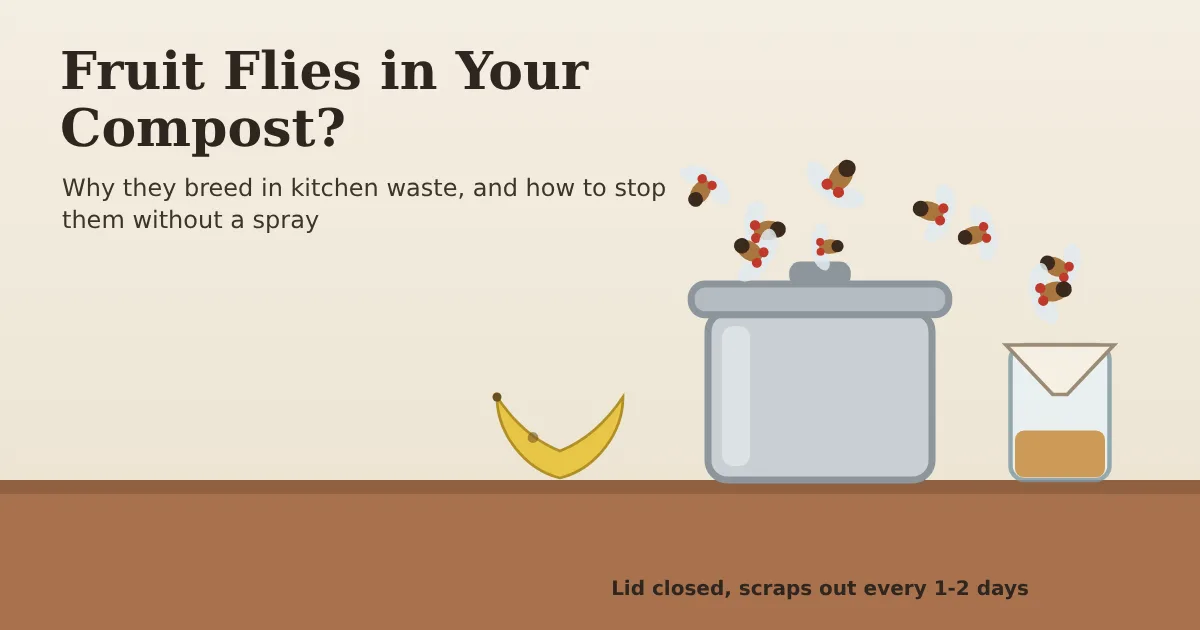
- A tight lid on the kitchen caddy matters most. Empty it every one or two days, or freeze scraps until you’re ready to take them out.
- In the compost bin, bury every load of fresh scraps under dry “browns” (carbon-rich material) such as shredded paper, cardboard or dry leaves.
- A jar with 2 to 3 cm of apple cider vinegar, a drop of dish soap and a paper funnel catches adults. It won’t end an infestation on its own.
- If flies keep coming back, check drains, mops, dish cloths, the onion and potato basket and the recycling bag. Sprays only kill the flies that are there at that moment.
In this article:
- First, check they’re fruit flies
- Why does compost attract fruit flies?
- Start with the kitchen caddy
- Then sort out the balcony bin
- Trapping the flies that are left
- Other places they breed
- A 14-day plan to clear fruit flies
- Frequently asked questions
- The bottom line
- About this guide
- Sources
First, check they’re fruit flies
Four kinds of small fly turn up in homes, and each one breeds somewhere different. The University of Kentucky’s entomology department groups them as fruit flies, fungus gnats, drain flies and phorid flies, and it notes that killing the adults of any of them only gives temporary relief. The fix is always to find where they’re breeding (University of Kentucky, Small Flies).
If they’re hovering over your compost or kitchen waste, they’re probably fruit flies. Kentucky describes them as about 3 mm (1/8 inch) long, usually with red eyes, a tan front half and a darker rear (University of Kentucky, Fruit Flies). The table below sets out the differences. If you’re not sure, trap one under a glass and look at its eyes: red usually means you’ve got fruit flies.
| Fly | What it looks like | Where it usually breeds | First place to look |
|---|---|---|---|
| Fruit fly | Tiny, tan, usually red eyes; hovers around fruit | Fermenting fruit, vegetable scraps, juice spills | Compost caddy, fruit bowl, wet-waste bin |
| Fungus gnat | Thin, dark, long legs; walks on potting soil | Moist soil and decaying organic matter | Overwatered pots and seed trays |
| Drain fly | Fuzzy, looks like a tiny moth; short, weak hops | Slime inside drains and moist corners | Kitchen and bathroom drains |
| Phorid fly | Humpbacked, runs in quick jerks | Garbage, clogged drains, decaying matter | Under sinks, blocked drains |
If the flies hang around your pot plants rather than your caddy, they’re probably fungus gnats, and the fix is to let the soil dry out between waterings. If they rest on the bathroom wall and look like tiny moths, you’re dealing with drain flies, which Kentucky says breed in the slime inside drains (University of Kentucky, Drain Flies). From here on, we’re dealing with the red-eyed ones over the caddy.

Why does compost attract fruit flies?
Fruit flies aren’t really after the fruit. They’re after the yeast growing on it. The University of Wisconsin’s guide explains that they lay their eggs near the surface of fermenting or rotting material, and the larvae feed on the yeast there (University of Wisconsin, Fruit Flies in the Home). A closed tub of mango peels, banana skins and wet tea leaves is exactly what they’re looking for.
How fast fruit flies multiply
The Wisconsin guide says the full cycle from egg to adult can finish in about 8 to 10 days. Indian lab work puts it in the same range. At the University of Delhi’s zoology department, where fruit flies are bred for long-running evolution studies, the standard populations take about 9.5 days from egg to adult (University of Delhi, microPublication Biology). Like most insects they develop faster in warm weather, which is why the problem flares up in summer and the monsoon.
So if scraps sit for several days and the lid lets flies in and out, a full generation can grow up inside the caddy. Everything below works on that cycle in one of three ways: it keeps adults off the food, buries the eggs under dry material, or gets scraps out of the kitchen before the larvae mature.
Which scraps are the worst
Some scraps are worse than others, and you’ve probably guessed which. Massachusetts’ composting guidance says banana peels seem to be the most common carrier of fruit fly larvae, which is why some composters keep them for an outdoor bin only (Massachusetts, Flies and Gnats). The eggs may already be on the fruit when it comes home from the market. Cornell University’s composting guidance also notes that a worm bin with too much citrus can turn too acidic, which may attract fruit flies (Cornell Waste Management Institute).
You don’t have to stop composting fruit. Just treat sweet, wet peels as the riskiest thing in the caddy.

Start with the kitchen caddy
Most fruit fly trouble starts in the small bin or dabba where you collect peels while you cook. Get that one container right and you’ve dealt with most of the problem.
Use a lid that actually seals
Beaufort County in South Carolina, which runs a home composting programme, calls a secure lid the most important thing you can do to prevent fruit flies in a kitchen compost bin (Beaufort County, Fruit Fly Tip Sheet). An open bowl or a twisted-shut plastic bag isn’t enough. A steel dabba with a tight lid, or a caddy with a rubber seal, keeps adults from reaching the scraps. It’ll also stop any flies that hatch inside from escaping into the kitchen.
It only works if it’s shut. Leaving it propped open while you chop vegetables lets the flies straight in.
Empty it every one or two days
The City of Charleston’s guidance for kitchen compost bins suggests holding only one or two days of scraps at a time, and keeping the bin outdoors in summer if you can (City of Charleston). With an 8 to 10 day life cycle, that’s a sensible interval. Eggs on bought fruit may already be a few days old, but emptying every one or two days still keeps most of them from finishing the cycle in your caddy.
If your building collects wet waste every morning, you’re most of the way there already. Our guide to household waste management in urban India covers how to set up wet and dry waste segregation if you haven’t yet. The Swachh Bharat Mission (Urban) also publishes a do-it-yourself guidebook on composting biodegradable waste at home (SBM-Urban, Ministry of Housing and Urban Affairs).
Freeze scraps when you can’t empty daily
If you only take scraps to the balcony bin or a community compost site a few times a week, use the freezer. Charleston notes that keeping scraps in the freezer between trips kills any fruit fly eggs on them. Tufts University’s sustainability team suggests the fridge or freezer for the same reason, and adds that it stops scraps from smelling (Tufts Gets Green). An old ice-cream tub at the back of the freezer does the job, and you won’t get the smell either.
Clean the caddy itself
Eggs and larvae can sit in the film of juice that’s under the lid and around the rim. Each time you empty the caddy, rinse it and wipe the lid’s underside. A quick wash with plain dish soap is enough. Let it dry before you refill it. It’s a two-minute job.

Then sort out the balcony bin
If the balcony bin is the one covered in flies, look at the top of the pile. That’s usually where the trouble is.
Bury every load under browns
Fruit flies need exposed, fermenting food on the surface to lay eggs on. Tufts recommends covering fresh scraps with brown material such as paper or leaves. In practice, each time you tip the caddy in, add a layer of dry browns on top so no wet scrap is showing. Shredded newspaper, torn cardboard egg trays, dry leaves and cocopeat all work. We’d keep a bag of them next to the bin so you’re never caught without.
Massachusetts’ guidance goes further: fruit flies in a compost bin usually mean the balance between food scraps and carbon material is off. If the top of your pile is wet, sticky and sweet-smelling, you’ll need more browns mixed in. Our guide to odour-free balcony composting explains the greens-to-browns balance for the three systems that work best in Indian flats.
Dig scraps in, don’t drop them on top
In a pot or bucket composter, dig a small hollow in the middle of the pile, tip the scraps in and cover them with the material you moved, then add browns on top. Flies can’t easily get at scraps that are buried.
Handle the high-risk scraps differently
If you’ve already got flies, go easy on banana peels and overripe fruit. Chop them up and bury them deeper, or keep them in the freezer until the flies are gone. There’s nothing wrong with feeding a worm bin kitchen scraps: Tamil Nadu Agricultural University’s vermicomposting guidance lists kitchen waste and rotting fruit and vegetables among the foods worms do best on (TNAU Agritech). Tuck them under the bedding; don’t leave them on top. Take out any food that’s rotting before the worms reach it, as Cornell advises, and don’t overload it with citrus.
Keep the bin covered
A loose lid or an open-top bucket lets flies come and go. If your bin has air holes, cover them with fine mesh or a cut piece of old cotton cloth held with a rubber band. Air still gets in; flies don’t.
| Problem you see | Likely cause | What to do today |
|---|---|---|
| Flies rise when you open the bin | Scraps on the surface | Add a thick layer of dry browns on top |
| Wet, sour or sweet smell | Too many greens, not enough carbon | Mix in shredded paper or dry leaves |
| Flies only after banana or mango days | Eggs arriving on the peels | Chop and bury peels deep, or freeze them first |
| Maggot-like larvae on top | Eggs laid days ago and left uncovered | Bury the top layer and cover with browns |
| Flies around the air holes | Open vents | Cover holes with fine mesh or cloth |
Our guide to turning kitchen waste into a household asset covers what happens next, when the finished compost goes into a kitchen garden.

Trapping the flies that are left
Once the caddy and bin are sorted, a trap catches the adults still flying around. Nebraska Extension in Lancaster County says traps speed things up but can’t replace removing food sources and breeding sites (Nebraska Extension, Fall Is the Time for Fruit Flies).
The vinegar and soap jar
Nebraska Extension’s trap takes five minutes to make (Nebraska Extension, Fruit Fly Trap):
- Pour about 2 to 3 cm (an inch) of apple cider vinegar into a small jar or glass.
- Add one drop of dish soap.
- Cover the top with a paper funnel, or with cling film poked with a few small holes.
- Place it next to the caddy, the bin or the fruit bowl.
Fruit flies are drawn to the smell of apple cider vinegar. The soap breaks the surface tension, so a fly that lands doesn’t walk off again. It sinks. The University of Kentucky recommends the same design, a jar with a paper funnel baited with cider vinegar, placed where the flies gather.
The fruit or wine jar
No cider vinegar in the house? Use whatever the flies are already after. The University of Wisconsin suggests a jar baited with ripe banana, pear or wine, with a funnel on top, for short-term control. Wisconsin also notes that old wine bottles with a little wine left inside will attract flies on their own.
What doesn’t help
Sprays aren’t worth the money here. Wisconsin points out that indoor sprays only kill the flies present at the time of spraying and leave no lasting effect. Kentucky adds that it’ll carry on however often you spray if the breeding site’s still there.
Don’t expect them gone overnight. Nebraska Extension notes that once the food sources are gone, it can take a couple of weeks for the remaining flies to die off. So don’t worry if you’re still seeing a few after a week.

Other places they breed
If the caddy is clean and the bin is well covered but the flies keep coming, they’re breeding somewhere else. Wisconsin calls finding and removing breeding sites the only complete solution. Its list of commonly missed spots, adapted here for an Indian kitchen:
Hidden spots to check
- The onion and potato basket. Wisconsin flags produce stored out of sight, such as onions and potatoes. One soft, rotting onion at the bottom of the basket can keep a whole kitchen supplied with flies, and you won’t spot it until you tip the basket out.
- Under the fridge and the gas stand. A peel or grape that’s rolled under an appliance weeks ago is exactly where Wisconsin suggests looking.
- Drains and the sink trap. Nebraska Extension lists drains and garbage disposals as possible breeding sites. Scrub the sink strainer and pour hot water down the drain. You’d be surprised what’s living in there.
- Mops, sponges and dish cloths. Nebraska also lists mops and cleaning rags. If a kitchen cloth smells sour, it’s already a breeding site. Wash it hot and let it dry fully before you use it again.
- Recycling and the dry-waste bag. Juice cartons, milk pouches and chutney jars put away unrinsed have all got a sweet film inside. Nebraska advises cleaning trash cans and recycling containers. Rinse before they go in the bag.
- The fruit bowl. Ripe fruit on the counter attracts flies even with no compost in the house. Once it’s ripe, eat it or move it to the fridge. Don’t leave it out for days.
- Spills. Charleston’s guidance is to clean up spills, especially juice, straight away.

A 14-day plan to clear fruit flies
Two weeks covers more than one full breeding cycle and gives the last adults time to die off.
| When | What to do | Why it works |
|---|---|---|
| Day 1 | Empty and wash the caddy; switch to a tight-lidded dabba | Removes eggs and keeps adults off the food |
| Day 1 | Bury the top of the compost bin under a thick layer of dry browns | Leaves no exposed scraps to lay eggs on |
| Day 1 | Set two vinegar and soap jar traps, one by the caddy and one by the bin | Catches the adults already flying |
| Day 2 | Check the onion basket, fruit bowl, under appliances and the drains | Finds breeding sites outside the compost |
| Day 2 | Wash mops, sponges and dish cloths hot and dry them fully | Removes damp, sour breeding spots |
| Days 1 to 14 | Empty the caddy every one or two days, or freeze scraps | Most eggs leave before they can become adults |
| Days 1 to 14 | Cover every new load in the bin with browns | Keeps the surface dry and buried |
| Day 7 | Refresh the traps and check which one catches more | Shows where the flies are coming from |
| Day 14 | Count the flies in the traps; most should be gone | Confirms the cycle is broken |
Still catching plenty after two weeks? Look within a metre or two of whichever trap is fullest. The source is usually close by.
Frequently asked questions
Are fruit flies from compost harmful?
They don’t bite, but they aren’t harmless either. The University of Kentucky’s small flies guide notes that small flies can carry bacteria from rotting material onto food. So keep fruit and cooked food covered while you clear them.
Should I stop composting until the flies are gone?
No, there’s no need. Keep composting, but store scraps in the freezer and bury every load in the bin under browns. Stopping just moves the same scraps into the wet-waste bin, where they ferment just as well.
Why do I get fruit flies even with a lid on my caddy?
Eggs often arrive on the fruit itself, especially bananas, and they may already be a few days old when the peel goes in. The longer scraps sit, the more of those eggs finish the cycle and fly out when you open the lid. Empty it more often or freeze scraps, and check the other breeding spots listed above.
Does vinegar alone work as a trap?
Some, but far fewer. Without soap, flies land on the surface and walk off again. The soap makes them sink. A paper funnel or cling film with small holes helps keep them in.
Will a bin outside the flat still attract fruit flies?
Yes, if scraps are left exposed on top. Having the bin on the balcony keeps flies out of the kitchen, but they’ll still breed in it unless you cover each load with browns.
The bottom line
Most fruit fly problems come down to scraps sitting too long with nothing over them. Keep the caddy shut and emptied every day or two, cover every load in the bin, and the flies run out of places to lay eggs. If you’re new to all this, our balcony composting guide helps you pick a bin that suits your space.
About this guide
Written by Amal Dominic for Towards Sustainability, a site of practical, sourced guides to greener living in Indian homes. This guide is based on published advice from university extension services and municipal composting programmes, listed below. We looked for Indian university guidance written specifically about fruit flies in home compost and couldn’t find any, so the fly-control steps come mostly from US extension services. The Indian sources cover fruit fly development, worm composting and home waste management. Fruit flies breed faster in warm weather, so in Indian summers and the monsoon, emptying the caddy often matters even more. Read our disclaimer, and contact us to report an error or suggest a correction.
Sources
- University of Kentucky Entomology, Small Flies (ENTFACT-657).
- University of Kentucky Entomology, Fruit Flies (ENTFACT-621).
- University of Kentucky Entomology, Drain Flies or Moth Flies (ENTFACT-615).
- University of Wisconsin Garden Facts, Fruit Flies in the Home.
- Department of Zoology, University of Delhi, faster pre-adult development in Drosophila melanogaster populations, microPublication Biology.
- Tamil Nadu Agricultural University, TNAU Agritech Portal, Organic Farming: Vermicompost FAQs.
- Swachh Bharat Mission (Urban), Ministry of Housing and Urban Affairs, Biodegradable Waste Management at Home: A Guidebook.
- Commonwealth of Massachusetts, Flies and Gnats in Compost.
- Cornell Waste Management Institute, Troubleshooting Worm Bins.
- Beaufort County, South Carolina, Fruit Fly Tip Sheet.
- City of Charleston, Managing Fruit Flies in Your Kitchen Compost Bin.
- Tufts Gets Green, Tufts University, Summer Compost Tips, 2019.
- Nebraska Extension in Lancaster County, Fall Is the Time for Fruit Flies.
- Nebraska Extension in Lancaster County, Fruit Fly Trap Instructions.
Images: original illustrations created for this article by Towards Sustainability.
