

Author

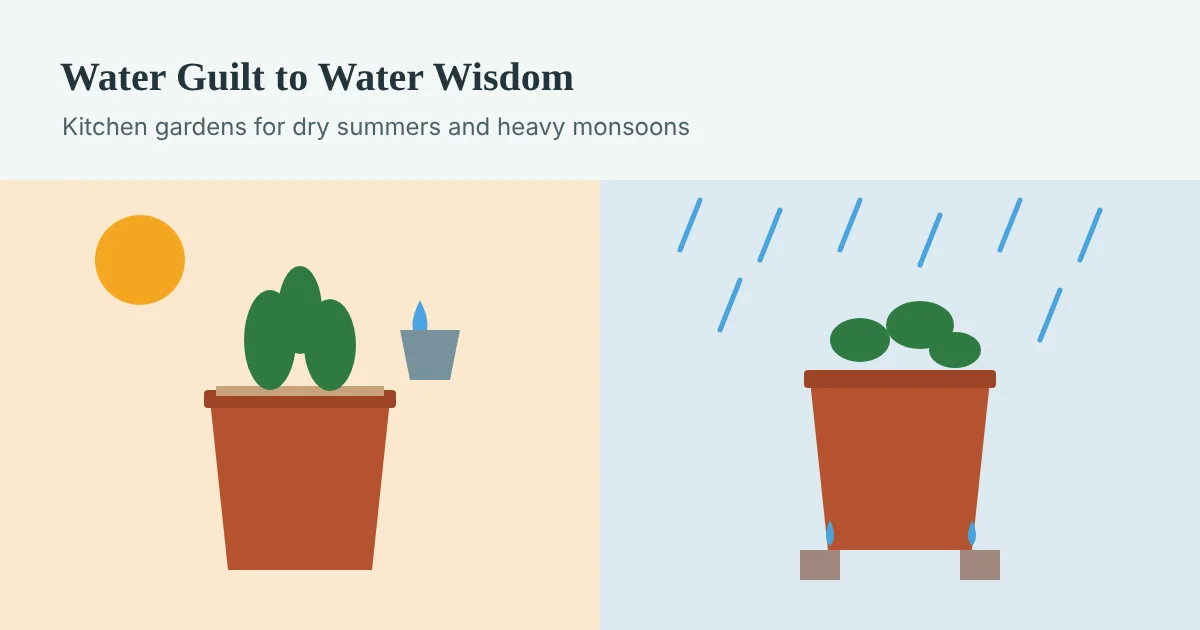
In May, when the society tanker is late and the overhead tank runs dry by noon, watering the tulsi and the chilli pots can feel almost selfish. By August the problem flips: rain lashes the balcony for a week, the pots fill like buckets, and the coriander rots at the roots.
Many urban gardeners in India swing between these two seasons, feeling guilty in one and helpless in the other. The fix is the same for both. A pot set up to hold water where the roots need it also lets surplus water out fast. Add a habit of using water the kitchen has already used once, and the garden stops competing with the household for its share.
Key Takeaways
- Water only when the top few centimetres of soil feel dry, and water deeply until it runs out of the drainage holes. Extension guides recommend this over fixed schedules.
- Mulch, larger pots and grouped pots all slow drying, so you water less often in summer.
- The same pots need side drainage holes and to stand on bricks or slats so monsoon rain can’t drown the roots.
- Plain vegetable-rinse and rice-wash water can go to the plants instead of the drain.

Why water feels tight in Indian cities
The guilt has a real basis. The Central Ground Water Board’s 2024 national assessment classified 751 of India’s 6,746 assessment units, or 11.13 percent, as over-exploited, meaning more groundwater is drawn than is recharged each year. Another 206 units were rated critical. The national picture has improved since 2017, when 17.24 percent of units were over-exploited, according to the Ministry of Jal Shakti’s release on the report (December 2024).
Rain has become harder to predict too. In the 2025 southwest monsoon, India as a whole received 108 percent of its long-period average, but the spread was uneven: Northwest India got 127 percent, central India 115 percent and the southern peninsula 110 percent, while East and Northeast India had a deficit, according to Down To Earth’s summary of the IMD annual statement (January 2026).

A balcony garden won’t change either trend. It can stop being part of the problem, though, by using less and wasting none in the dry months, and by coping with heavy rain without losing a season’s plants.
Water only when the soil asks for it
A common way to waste water on pots is watering on a fixed timetable. Extension gardeners at Washington State University suggest pushing a finger a few centimetres into the soil: if it’s moist, wait, and if it’s dry, water. They add that plants may need water every day in the hottest part of summer, so check daily until you learn your pots’ rhythm (WSU Extension, Container Gardening tip sheet).
When you do water, water slowly and deeply. Oregon State University’s guide recommends a slow soaking until water drains from the holes, then a second finger check to make sure the moisture reached at least 5 cm down (OSU Extension, Watering Basics). A quick splash wets the surface, evaporates by noon and leaves the roots dry.
Water early in the morning, before the balcony heats up. The same OSU guide warns against wetting leaves in the evening, because damp leaves overnight encourage fungal disease.
Make each litre last longer in summer
Cover the soil
OSU notes that soil covered by straw or other mulch holds water better, so you may be able to water less often. On a balcony, dry leaves, shredded coconut husk or a layer of compost all work. Keep the mulch a finger’s width away from stems.
Use bigger pots, and group them
A small pot has little soil to store water and dries out fastest. WSU points out that container plants can’t send roots deeper to find water, so the pot is all they have. Move thirsty plants like tomatoes and brinjal into the largest containers you have, and stand smaller pots close together so they shade each other.
Bury a matka
OSU describes the olla, an unglazed clay pot buried in the soil with its mouth just above the surface. You fill it, cover it, and water seeps slowly through the clay into the soil around the roots. Indian gardeners will recognise the idea from the matka. A small unglazed clay pot sunk into a large container or grow bag can carry the plant through a hot day. OSU adds that it works best in loose, crumbly soil and that seedlings still need watering from above until their roots reach the pot.

Reuse what the kitchen already used
The kitchen sends a steady stream of clean-enough water down the drain. Collect it in a bucket or bottle by the sink:
- Water from rinsing vegetables, fruit and dal.
- Water from washing rice.
- The cold water that runs from a geyser or tap before it warms up.
Use it the same day, and only if it has no soap, salt or oil in it.
This is general gardening practice; we found no Indian study measuring how much household water it saves.
RO purifier reject water is a different case. It carries the minerals the filter removed, so it’s saltier than the tap water that went in. If you use it at all, mix it with ordinary water and keep it away from salt-sensitive seedlings.
Getting the same pots through the monsoon
In heavy rain the risk is too much water, not too little. Roots need air as well as water, and soil that stays soaked for days suffocates them. OSU warns that overwatering causes root damage and disease and can turn leaves yellow and make them drop.
Drain from the side, and lift the pot
OSU’s container guide recommends drilling drainage holes in the side of the pot, about a centimetre above the base, and raising it on bricks or wooden slats so it isn’t sitting on concrete or in a saucer of water (OSU Extension, container gardening). Before the rains arrive, check every pot. A single blocked bottom hole is enough to waterlog a pot during a week of downpours.
Use potting mix, not garden soil
OSU advises against filling containers with garden soil or topsoil, and WSU notes that bought potting mixes are lighter and drain better. A light mix of compost and cocopeat with a little sand works well in pots. Our guide to odor-free balcony composting covers ways to make the compost at home.
Empty saucers and trays after rain
Standing water in saucers keeps the bottom of the pot soggy, and it’s also where mosquitoes breed. Tip saucers out after every heavy shower, or take them away for the monsoon months.
Matching plants to the season
Choosing what to grow can save more water than any watering trick. In the dry months, lean on tough, deep-rooted pot plants such as curry leaf, lemongrass and chillies, and keep thirsty leafy greens to a few well-mulched pots in shade. When the monsoon arrives, switch the space to crops that like steady moisture, such as amaranth, Malabar spinach, and ginger or turmeric in deep grow bags.
These pairings are general practice for Indian conditions and vary by region. For more plants sorted by sun and space, see our balcony garden guide for Indian apartments.
| Season | Main risk | What to change |
|---|---|---|
| Summer (March to May) | Pots dry out by afternoon | Finger test, deep morning watering, mulch, matka, kitchen rinse water |
| Monsoon (June to September) | Waterlogged roots, mosquitoes | Side drainage holes, pots on bricks, saucers emptied, moisture-loving crops |
| Post-monsoon and winter | Overwatering in cooler weather | Water less often, check soil before every watering |
Months are approximate and differ across India.
Catching the rain for later
A bucket under a dripping balcony ledge or a covered drum by a terrace downpipe can collect rain for the first dry weeks after the monsoon. Keep every container covered with a lid or fine mesh so mosquitoes can’t breed in it, and use the water within a few weeks. Check with your housing society before tapping into a shared downpipe.
Free download: the Balcony Kitchen Garden Kit
Turn this guide into a plan you can stick on the fridge. The kit has 16 printable A4 pages, including a balcony audit, a plant picker, a 10-minute weekly planner, a heat-season shade plan, a watering log and a monsoon-prep checklist.
It also has a monthly watering log for the finger test and a pot-by-pot monsoon checklist.
The PDF opens as soon as you press the button. We only email you if you tick the box.
Frequently asked questions
How often should I water balcony vegetables in summer?
There’s no fixed number. Extension guides suggest checking daily with a finger and watering only when the top few centimetres are dry. In peak summer that may mean every day, and small pots in full sun may need checking twice.
Is it wrong to water plants during a water shortage?
Not if the water would otherwise be wasted. Kitchen rinse water, deep watering only when needed, and mulch together keep a small kitchen garden’s needs low. During severe shortages, keep the perennials like curry leaf alive and pause new sowings.
Will a clay matka work in a small pot?
It works best in large pots, grow bags and raised beds with loose soil. In a small pot the matka takes up too much of the root space.
Why do my plants turn yellow in the monsoon?
The most common cause is waterlogged roots. Check that drainage holes are clear, lift pots off the floor and empty any saucers. Soil that stays wet for days needs a lighter potting mix.
Sources
- Ministry of Jal Shakti, Dynamic Ground Water Resource Assessment Report of the Country for the Year 2024, Press Information Bureau, December 2024.
- Down To Earth, 2025 marked by rising night-time temperatures and extreme rainfall across seasons in India, January 2026.
- Oregon State University Extension Service, Watering Basics.
- Oregon State University Extension Service, Container gardening: Grow vegetables even without yard space.
- Washington State University Extension, King County Master Gardeners, Container Gardening tip sheet.
