

Author

Most terrace-garden advice assumes you have free evenings. You water every day, sow every fortnight and inspect every yellow leaf. If you work, or have children, or both, that garden turns into one more chore on a long list, and in a busy month it is usually the first thing to die.
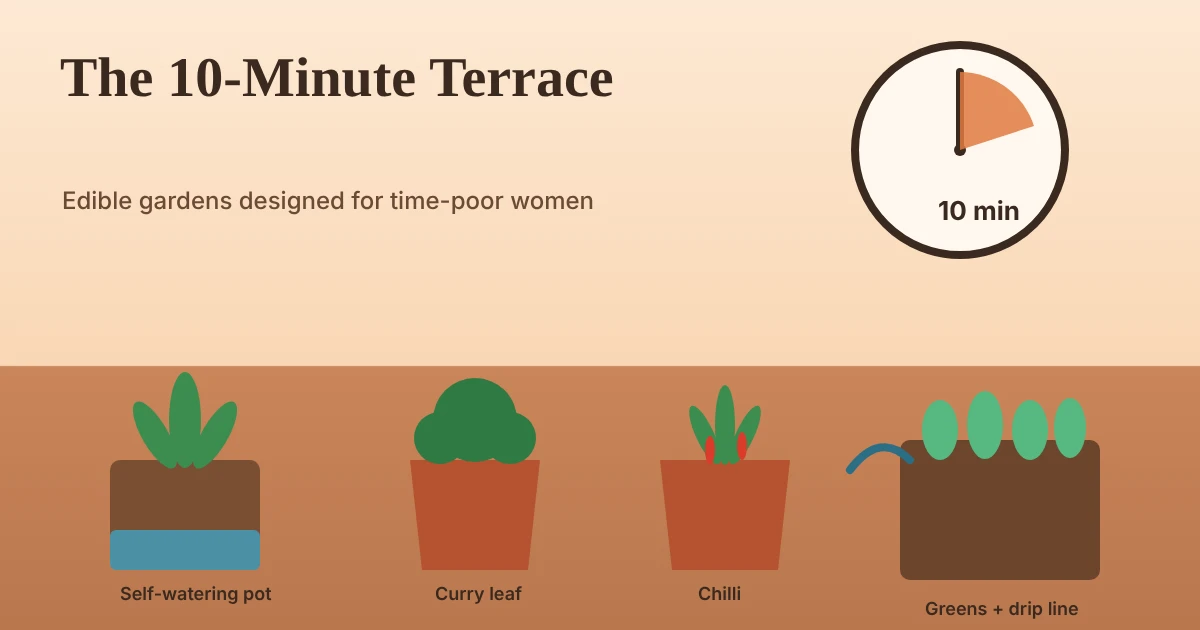
So start with the time you actually have. Say it is about 10 minutes a day. Then set up the garden to fit: let pots and pipes do the watering, plant crops that keep producing for years, and pick while you cook. You won’t find a long plant list here; our balcony garden guide with 50+ plants for Indian apartments already covers that.
Key Takeaways
- Plan the garden around about 10 minutes a day, with daily picking built in.
- Watering is the one job that can’t wait, so hand it to self-watering pots, a drip line with a timer, and mulch.
- Perennials such as curry leaf and chekkurmanis end the replanting cycle. An article in ICAR’s Indian Horticulture notes three harvests a year and 10+ years of productive life for curry leaf on farms.
- Keep the garden where you already walk and pick while you cook, so it saves time at the stove.
- Give one task to someone else at home, and plan a “holiday mode” so a busy fortnight doesn’t mean starting over.
In this article:
- Why kitchen gardens fail busy women
- Your 10-minute budget
- Step 1: Automate the watering
- Step 2: Plant once, pick for years
- Step 3: Add a few fast annuals
- Step 4: Pick while you cook
- Share the load
- When you have no time at all
- What to expect from 10 minutes a day
- Your first weekend: a one-hour setup
- Frequently asked questions
- About this guide
- Sources
Why kitchen gardens fail busy women
Most kitchen gardens are planned around plants. Few are planned around the gardener’s week, and in Indian homes that week is already full of unpaid work.
India’s Time Use Survey 2024, from the Ministry of Statistics and Programme Implementation, found that women who do unpaid domestic work spend an average of 289 minutes a day on it. Men who do such work spend 88 minutes (PIB / MoSPI, Time Use Survey 2024, February 2025; participants aged 6 and above). The survey also found that 81.5 percent of women took part in unpaid domestic work, compared with 27.1 percent of men.
Caregiving adds more. Female participants aged 15 to 59 spent about 140 minutes a day on it, compared to 74 minutes for men. Across all participants aged 6 and above, the figures are 137 and 75 minutes, as charted below.
A garden that needs an hour of watering, sowing and spraying lands on top of all that. In a typical terrace garden, most of that hour goes on three jobs: watering by hand, which can’t be skipped in an Indian summer; replanting short-lived crops every few weeks; and nursing plants that got stressed when a watering was missed.
Take those three away and what’s left fits between the pressure-cooker whistle and the school bus.
Your 10-minute budget
Ten minutes a day comes to about 70 minutes a week. With the watering automated, the daily part stays short. Most days you only glance at the plants and pick something for dinner, and one weekly slot covers the upkeep.

| When | Time | What you do |
|---|---|---|
| Daily | 2 to 3 minutes | Walk past, look at leaves and soil, pick what you need for the day’s cooking |
| Daily (summer only) | 2 minutes | Check self-watering reservoirs or the drip timer display |
| Weekly (“Sunday slot”) | 20 to 30 minutes | Top up reservoirs, trim and harvest greens, sow one small batch, add compost or mulch |
| Monthly | 15 minutes | Prune perennials, check drip emitters, replace one tired plant |
These times are our editorial planning estimates for a garden of roughly 8 to 12 containers, not measured averages.
Put the garden somewhere you pass anyway, like the balcony next to the kitchen or the landing on the way up to the terrace. If you have to make a special trip to reach it, you’ll skip it.
What the Sunday slot includes: a two-minute leaf check
In your Sunday slot, turn over a few leaves on each plant and pinch off any that are yellow, spotted or chewed. One bad leaf takes seconds to deal with; a struggling plant takes weeks. This is general practice; for a pest that keeps coming back, ask your local Krishi Vigyan Kendra or nursery.
Step 1: Automate the watering
Start with watering, because it’s the only job that can’t wait. Pruning or sowing can slip a week. A dry pot in May won’t last that long.
Self-watering (wicking) pots
A self-watering pot holds a reservoir of water at the bottom. A wick, or a column of potting mix, draws water up to the roots as the soil dries, so you refill the reservoir every few days instead of watering every day.

You can make one from two buckets of the same size:
- Cut a hole in the base of one bucket for the wick. A strip of cotton cloth works, or a small perforated cup filled with potting mix.
- Nest that bucket inside the second one. The gap underneath is the reservoir.
- Drill a small overflow hole in the outer bucket just below the base of the inner one, so rain can’t flood the roots.
- Push a short pipe down the side for refilling.
- Fill the inner bucket with light potting mix, not heavy garden soil.
This is general practical guidance; reservoir size and refill frequency depend on the plant, the pot and the season.
Drip line with a tap timer
With more than a dozen pots, or if you travel often, a drip line with a battery timer on the tap does the watering for you. In Tamil Nadu, for example, the Agriculture-Horticulture Department has offered a subsidised do-it-yourself drip kit for home gardeners. In 2021 its automatic version, with a 9-volt battery timer, was priced at ₹2,880, and an official said 60 pots can be irrigated within 15 minutes (Mylapore Times, March 2021). Ask your state horticulture department what schemes and prices apply now.
If your tap water carries sediment, fit a small filter. And check every fitting the day the kit arrives, rather than the night before a trip.
Protect the terrace floor
Stand every pot on a tray or a raised stand so water never pools on the terrace, and keep the drain outlets clear. In older buildings, check with your society before you put heavy, water-filled containers on the roof.
Mulch and shade
A layer of dry leaves, coconut coir or straw over the soil slows evaporation on a hot terrace. In north Indian summers, a shade net on the afternoon side helps the plants and stretches the time between refills.
Step 2: Plant once, pick for years
Perennials do most of the work in a 10-minute garden. You plant them once and keep harvesting, with no resowing every few weeks.

Curry leaf is the plant to build around. An article in ICAR’s Indian Horticulture describes it as a perennial leafy vegetable with “low input costs, three harvests per year” and “more than 10 years of plantation viability” (Raghu, Aghora and Dhananjaya, Indian Horticulture). Those are farm figures. In a large pot, the same habit means one plant and years of tadka.
Chekkurmanis (also spelled chekurmanis; sweet leaf, Sauropus androgynus) is another green you plant once. ICAR’s Indian Horticulture calls it a perennial green that “can be easily grown in hot and humid tropical climate” (Verma and Sood, Indian Horticulture, 2018). A second article in the same journal says it is grown mainly from stem cuttings 20 to 30 cm long. The first leaves are plucked 3 to 4 months after planting, then about once a month through the year (Yadav and Kumar, Indian Horticulture).
| Plant | Container | Time per week | What you get | Notes |
|---|---|---|---|---|
| Curry leaf | Large pot, 45 cm or more | 2 minutes | Leaves for tadka year-round | Slow to start; buy a sapling, not seeds |
| Chekkurmanis | Large pot or grow bag | 2 minutes | Leafy greens for sabzi | Does best in warm, humid regions |
| Malabar spinach (basella) | Grow bag with a support | 3 minutes | Thick leaves for dal and sabzi | Climber; grows fast in the monsoon |
| Lemongrass | Medium pot | 1 minute | Stalks for chai and soups | Hard to kill |
| Mint / pudina | Wide, shallow self-watering trough | 2 minutes | Leaves for chutney and drinks | Likes steady moisture, so a wicking pot suits it |
Container sizes and weekly times are editorial rules of thumb for small-space gardens.
Step 3: Add a few fast annuals
Once the perennials have settled, add a few quick, forgiving annuals, and only ones your family already cooks with. Cut-and-come-again greens like chaulai (amaranth), palak and methi fit a short routine, along with coriander sown in small batches every few weeks and a couple of chilli plants.
If nobody at home eats something, leave it out, however easy it is to grow. For what to sow when in your region, use our winter balcony garden guide with the thali method.
Step 4: Pick while you cook
The garden saves the most time when picking happens during cooking. A three-pot “tadka corner” by the kitchen window or balcony door, with curry leaf, chilli and coriander, covers much of the everyday tadka.

Pick while the chai boils or the dal cooks. Snipping a handful of curry leaves is quicker than hunting for the packet in the fridge, and it gives you your daily look at the garden without a separate trip.
Share the load
Hand over a specific job, with an owner, to someone else at home. A teenager can do the weekly reservoir top-up, a younger child can sow the coriander, and a partner can take the monthly drip-line check. A job everyone “shares” tends to drift back to the person who already does everything.
In apartment complexes, neighbours can share the terrace and the work. At Ittina Anai Apartment in Bellandur, Bengaluru, one family’s terrace garden grew into a community initiative in which five families have gardens on the rooftop (Citizen Matters, January 2022).
When you have no time at all
Plan a “holiday mode” so that a work trip, exam season or a family wedding doesn’t mean starting again.
Before you leave, harvest whatever is ready, fill every reservoir, add fresh mulch and move the pots into partial shade. Self-watering pots, mulched perennials and anything on a timer usually come through a short absence; leafy annuals may bolt. When you’re back, use one Sunday slot to trim, resow a batch of coriander or greens, and check the timer battery.
It’s fine if a few annuals go to seed while you’re away. The perennials and the watering setup keep the garden alive through the busy weeks.
What to expect from 10 minutes a day
Expect herbs, greens and seasonings rather than your whole sabzi basket. Our editorial estimate is that 8 to 12 containers run this way can keep you in curry leaves, chillies, coriander, mint and a few bunches of greens for much of the year. Those are the small, frequent buys that send you to the market, so we expect most of the time saved to come from there.
You might feel better for it too, though the research is early. A small pilot trial published in PLOS ONE in 2022 randomly assigned healthy women aged 26 to 49 to group indoor gardening or art sessions. Of these, 32 completed the eight one-hour sessions and the assessments. Both groups improved on self-reported mood disturbance, depression symptoms and perceived stress, and the gardening group also improved on trait anxiety (Odeh et al., PLOS ONE, 2022). With so few participants, it’s a hopeful sign rather than proof.
Your first weekend: a one-hour setup
Start small and add one system a month. For the first weekend:
- Choose a spot you walk past anyway, with at least a few hours of sun.
- Set up three self-watering pots, bought or made from buckets.
- Plant the tadka corner: a curry leaf sapling, a chilli seedling and a batch of coriander.
- Mulch the surface of every pot.
- Set a weekly phone reminder for your Sunday slot.
Once the garden is running, you can feed it with your kitchen waste. Our guide to odor-free balcony composting shows how, and our household waste management guide covers segregation.
Free download: the Balcony Kitchen Garden Kit
Turn this guide into a plan you can stick on the fridge. The kit has 16 printable A4 pages, including a balcony audit, a plant picker, a 10-minute weekly planner, a heat-season shade plan, a watering log and a monsoon-prep checklist.
It also has the first-weekend setup checklist and the two-bucket self-watering pot from this guide, ready to print.
The PDF opens as soon as you press the button. We only email you if you tick the box.
Frequently asked questions
How much time does a terrace kitchen garden need each week?
Set up this way, up to about 70 minutes a week: a few minutes a day for picking and checking, a 20 to 30 minute weekly slot, and a short monthly task. These are our planning estimates. A garden that depends on hand-watering and short-lived crops takes much longer.
Which vegetables need the least care in India?
Perennials such as curry leaf, chekkurmanis, lemongrass and mint need the least ongoing work, followed by cut-and-come-again greens such as amaranth and palak. Choose by what your family eats and your region’s climate.
Do self-watering pots work in Indian summers?
They help a lot, especially with mulch and afternoon shade, but the reservoirs empty faster in May and June, so check them more often then.
Can I keep a kitchen garden if I travel often?
Yes. Lean on perennials, self-watering pots and a drip line with a timer, and run through the holiday-mode steps before you leave.
What if my balcony gets little sun?
Grow leafy greens, mint and herbs, which manage with less sun than fruiting crops like chillies and tomatoes, and give the brightest spot to the plants you pick most.
About this guide
The Towards Sustainability editorial team researched and wrote this guide; we cover practical sustainable living for Indian homes. We checked every statistic and quotation against the source linked in the text and listed below. Time budgets, container sizes and setups are marked as our editorial estimates or general practice. Learn more about Towards Sustainability, read our disclaimer, or contact us with corrections.
Sources
- Press Information Bureau / Ministry of Statistics and Programme Implementation, Time Use Survey (TUS) January–December 2024, February 2025.
- Raghu, Aghora and Dhananjaya, Genetic improvement of curry leaf in India: Challenges and future prospects, Indian Horticulture (ICAR).
- Verma and Sood, Chekkurmanis is a mineral-rich leafy green, Indian Horticulture (ICAR), 2018.
- Yadav and Kumar, Chekkurmanis: Multi-mineral packed leafy vegetable, Indian Horticulture (ICAR).
- Odeh et al., A pilot randomized controlled trial of group-based indoor gardening and art activities demonstrates therapeutic benefits to healthy women, PLOS ONE, 2022.
- Mylapore Times, Do It Yourself drip-watering kit for home gardeners, March 2021.
- Citizen Matters, How this Bellandur apartment set up a kitchen garden on the terrace, January 2022.
