

269
Choose Your Soil Solution
Additional Benefits:
Benefits:
Results: Adoption of subsurface drainage resulted in a 3-fold increase in farmers’ income, with yields increasing: Paddy 45%, Wheat 111%, Cotton 215%.
Year-by-Year Changes:
 Building bunds without grass. Washes away in the first rain
✓ Plant grass immediately (Rs 500-1,000 saves entire investment)
Expecting instant organic farming results → Year 1 yield may drop
✓ Plan for 2–3-year transition, yields exceed chemical by Year 3
Installing drainage without proper survey → System fails, Rs 70,000 wasted
✓ Rs 5,000 survey protects Rs 70,000 investment
Burning crop residue → Lose organic matter + pay penalty
✓ Chop and mulch (Rs 800-1,200) – cheaper than Rs 2,500-15,000 penalty
Over-irrigation “to be safe” → Creates waterlogging disaster
✓ Use a piezometer (Rs 100), follow the AWD method
Key Contacts
Soil Testing: District agriculture office or search “soil testing lab near me”
Equipment Rental: Contact the ATMA office or the nearest KVK for Custom Hiring Centers
Subsidies: District Agriculture Officer (DAO) or Block Development Office
Technical Help: KVK (https://kvk.icar.gov.in) or call the district agriculture office
Salinity/Drainage: ICAR-CSSRI, Karnal – 0184-2209110
Online Resources:
Building bunds without grass. Washes away in the first rain
✓ Plant grass immediately (Rs 500-1,000 saves entire investment)
Expecting instant organic farming results → Year 1 yield may drop
✓ Plan for 2–3-year transition, yields exceed chemical by Year 3
Installing drainage without proper survey → System fails, Rs 70,000 wasted
✓ Rs 5,000 survey protects Rs 70,000 investment
Burning crop residue → Lose organic matter + pay penalty
✓ Chop and mulch (Rs 800-1,200) – cheaper than Rs 2,500-15,000 penalty
Over-irrigation “to be safe” → Creates waterlogging disaster
✓ Use a piezometer (Rs 100), follow the AWD method
Key Contacts
Soil Testing: District agriculture office or search “soil testing lab near me”
Equipment Rental: Contact the ATMA office or the nearest KVK for Custom Hiring Centers
Subsidies: District Agriculture Officer (DAO) or Block Development Office
Technical Help: KVK (https://kvk.icar.gov.in) or call the district agriculture office
Salinity/Drainage: ICAR-CSSRI, Karnal – 0184-2209110
Online Resources:
Author

💡 Choose Your Solution Based on Your Problem
Identify Your Soil Issue and Get the Right Solution
Each solution is backed by real farmer success stories and government subsidies up to 75%
🔍 What’s Happening in Your Field?
Select the problem that best describes your situation. Each card shows symptoms, recommended solution, costs, and expected returns.
Topsoil Erosion (Flat Land)
- Water flowing in channels across fields
- Visible gullies forming after rain
- Soil depositing at field edges
- Topsoil washing away during monsoon
Recommended Solution
Contour Bunding + Zero Tillage
₹25,000
Initial Cost/ha
₹11,500
Annual Benefit/ha
3-5 yrs
Payback Period
60-75%
PMKSY Subsidy
Severe Waterlogging
- Standing water for days after rain
- White salt patches on soil surface
- Crops yellowing in patches
- Poor germination and growth
Recommended Solution
Subsurface Drainage System
₹65,000
Initial Cost/ha
₹60,000
Annual Benefit/ha
4-7 yrs
Payback Period
50%
State Subsidy
Poor Soil Health
- Rising fertilizer costs each year
- Declining yields despite good inputs
- Soil feels hard and compact
- Crops weak and stunted growth
Recommended Solution
Zero Tillage + Organic Inputs
₹10,000
Initial Cost/ha
₹16,000
Annual Benefit/ha
Immediate
Payback Period
50%
PKVY Subsidy
Hillside Erosion
- Steep slopes difficult to farm
- Soil sliding downhill
- Uneven moisture distribution
- Rocks and stones appearing
Recommended Solution
Contour Terracing
₹47,500
Initial Cost/ha
₹40,000
Annual Benefit/ha
5-8 yrs
Payback Period
60%
Horticulture Subsidy
Light Erosion (Prevention)
- Minor soil movement visible
- Bare soil exposed between crops
- Want to prevent future problems
- Looking for low-cost solutions
Recommended Solution
Cover Crops + Mulching
₹3,000
Initial Cost/ha
₹6,500
Annual Benefit/ha
1-2 yrs
Payback Period
Minimal
Subsidy
Why This Matters for Your Farm
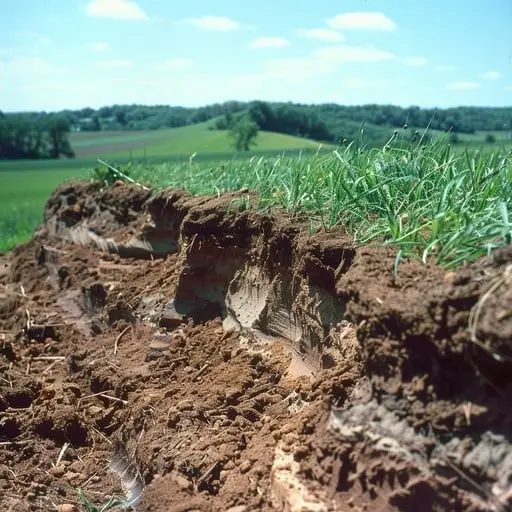
India faces a critical soil crisis. Approximately 30% of India’s total land area is affected by soil erosion, with potential soil loss of 21 tonnes per hectare per year. This results in approximately Rs 68 billion in economic damage to Indian agriculture annually. For you as a farmer, this means:- Direct Income Loss: 8% average productivity loss on 78 million hectares
- Rising Input Costs: 15-25% more fertilizer needed for the same yields
- Reduced Farm Value: Eroded land sells for 30-40% less
- Bund height: 0.45-0.75 meters
- Top width: 0.3-0.6 meters
- Vertical interval: 1.2-2.5 meters (depends on slope)
- Side slopes: 2:1 ratio
- Survey: Rs 500-800/ha
- Earthwork: Rs 8,000-20,000/ha (varies by method)
- Grass planting: Rs 500-1,000/ha
- Total: Rs 9,000-22,000/ha
- With 60% PMKSY subsidy: Rs 3,600-8,800/ha
- Mark contours with an A-frame (make yourself, Rs 200)
- Construct bunds (tractor with blade: Rs 8,000-15,000/ha)
- Plant grass immediately (Vetiver, Napier)
- Best timing: April-May, before monsoon
- Rainfed crops: 15-25% increase
- Moisture retention: 20-30% better
- Benefit-Cost Ratio: 2.5:1 to 3.5:1 over 10 years
- Leave 30-40 cm crop stubble (don’t burn)
- Hire Zero-Till drill: Rs 800-1,200/ha
- Plant directly through stubble
Cost Comparison Per Hectare:
| Operation | Conventional | Zero-Till | Savings |
| Plowing + Harrowing | Rs 2,500-3,200 | Rs 0 | Rs 2,500-3,200 |
| Seeding | Rs 800-1,000 | Rs 800-1,200 | Rs 0 |
| Diesel | Rs 1,200-1,500 | Rs 300-400 | Rs 900-1,100 |
| Irrigation water | Rs 4,000-5,000 | Rs 2,800-3,500 | Rs 1,200-1,500 |
| TOTAL | Rs 9,000-11,500 | Rs 3,900-5,100 | Rs 5,100-6,400 |
- Wheat yield: 5-15% higher (Rs 6,000-10,000 extra)
- Time saved: 7-10 days
- Erosion reduced: 40-60%
Where to Find Equipment: Contact Krishi Vigyan Kendra (KVK), ATMA office, or local FPOs for Custom Hiring Centers.
Solution 1C: Cover Crops (Low-Cost Prevention) Best Options:| Cover Crop | Seed Cost | N-Fixation | Growth Period |
| Dhaincha | Rs 400-600/ha | 60-80 kg N/ha | 45-60 days |
| Sunhemp | Rs 800-1,200/ha | 40-60 kg N/ha | 60-75 days |
| Moong | Rs 3,000-4,000/ha | 40-50 kg N/ha + grain | 60-70 days |
- Erosion reduction: 50-70%
- Free nitrogen = Rs 2,000-4,000 saved
- Organic matter: 2-4 tonnes/ha added
- Water table depth < 1.5 meters year-round
- Soil salinity (ECe) > 4 dS/m
- More than 30% area affected
- Pipe depth: 1.5-2.0 meters
- Pipe spacing: 20-50 meters (depends on soil type)
- Pipe diameter: 75-100 mm perforated PVC
- Gravel envelope: 50-100 mm thickness
Complete Cost Breakdown:
| Component | Cost (Rs/ha) |
| Survey & design | 3,000-5,000 |
| PVC pipes | 22,000-35,000 |
| Gravel envelope | 8,000-12,000 |
| Excavation | 12,000-18,000 |
| Installation & supervision | 12,000-18,000 |
| TOTAL | 65,000-101,000 |
| Average | Rs 75,000/ha |
| With a 50% subsidy | Rs 37,500/ha |
- Year 1: Water table drops 0.3-0.5m, yield +15-25%
- Year 2: Salinity drops 50-60%, yield +40-60%
- Year 3-5: Full yield potential, 3x income achieved
- Install simple piezometer (PVC pipe with holes: Rs 50-100)
- Irrigate then let it dry to 15 cm below the surface, then irrigate again
- Water saved: 400-500 mm per season
- Yield impact: Same or 5-10% better
- Even water distribution, 20-25% water saving
- Cost: Rs 1,200-1,800/ha (custom hire)
- Subsidy: 40-50% under PMKSY
- Frequency: Once every 3-4 years
- Application rate: 5-10 tonnes/ha
- Cost: Rs 4,000-12,000/ha
- Apply before monsoon, reclamation in 2-3 years
Three-Step Restoration Plan
Step 1: Get Soil Testing (Essential!)- District labs: Free or Rs 20-50
- Private labs: Rs 200-500 (faster results)
- Test for: NPK, organic carbon, pH, micronutrients, EC
- Zinc sulphate: 25 kg/ha
- Cost: Rs 500-800/ha
- Frequency: Once every 2-3 years
- Yield impact: 10-20% increase
- Wheat: 120:60:30 NPK per hectare
- Rice: 100:50:25 NPK per hectare
- Follow soil test recommendations
- Farmyard Manure: 10-15 tonnes/ha, Rs 20,000-45,000/ha
- Vermicompost: 2-3 tonnes/ha, Rs 12,000-24,000/ha (50% PKVY subsidy)
- Green Manuring: Dhaincha before main crop, only Rs 400-1,200/ha seed cost
- Crop Residue: Chop and return (free, saves burning penalty)
- Zero-till rental: Rs 1,000/season
- Cover crop seed: Rs 800/ha (50% subsidy = Rs 400)
- Vermicompost: Rs 15,000/ha (50% subsidy = Rs 7,500)
- Micronutrient correction: Rs 1,500/ha
- Total out-of-pocket: Rs 10,400/ha
- Tillage cost saving: Rs 3,500
- Fuel saving: Rs 1,200
- Water saving: Rs 1,500
- Yield stability increase (10%): Rs 8,000
- Total: Rs 14,200/ha
- Years 1-3: Establishment, Rs 30,000-40,000/ha from intercrop
- Years 4-6: Rs 40,000-80,000/ha
- Years 7+: Rs 150,000-250,000/ha
- Payback: 6-8 years, IRR: 22-28%
Real Success Stories
Case Study 1: Ramesh Kumar – Zero Tillage, Bihar
Farm: 1.8 hectares, Vaishali district Problem: Rising tillage costs, delayed planting Results Per Season:- Savings: Rs 6,500 (tillage) + Rs 1,400 (fuel) + Rs 2,200 (irrigation)
- Extra yield: 4 quintals of wheat = Rs 8,000
- Total benefit: Rs 17,200/ha
- By 2024: Formed a group, purchased a drill collectively
Case Study 2: Kuldeep Singh – Subsurface Drainage, Haryana
Farm: 4 hectares, Rohtak Problem: 2.5 ha waterlogged, ECe 9.2, poor yields Investment: Rs 2,80,000 (Rs 1,40,000 after subsidy) Results (5 Years):| Year | Wheat (q/ha) | Cotton (q/ha) | Net Income |
| 2018 (Before) | 18 | 8 | Rs 80,000 |
| 2021 | 38 | 18 | Rs 2,20,000 |
| 2023 | 42 | 22 | Rs 2,80,000 |
Case Study 3: Savitri Devi – Women-Led Watershed, Maharashtra
Community: 42 women farmers, 35 acres, Marathwada Intervention: Contour trenches, farm ponds, organic farming (2016-2019) Results:- Input costs: -57% (Rs 35,000 → Rs 15,000)
- Crop income: +56% (Rs 48,000 → Rs 75,000)
- Organic premium: Rs 12,000/year
- Net savings: Rs 52,000/year per household (+108%)
- Soil organic carbon: 0.8% to 2.1%
Case Study 4: Krishnan Nair – Organic Transition, Tamil Nadu
Farm: 1.5 hectares, Vadukampadi Journey: 15 years chemical farming → Organic (2017-2024) Year-by-Year:- Year 1: Yield dropped 20%, loss Rs 25,000
- Year 2: Yield recovered to 90%
- Year 3: Yields equal to chemical farming, profit Rs 40,000 more
- Years 4-7: Yields 10-15% higher, input costs 60% lower
- Gross income: Rs 95,000
- Input costs: Rs 12,000 (vs Rs 35,000 before)
- Net profit: Rs 58,000 (53% higher than chemical farming)
Government Schemes Access
- PMKSY – Watershed Component
- PKVY – Organic Farming
- State Schemes
- Land ownership proof (7/12, Khasra, Patta)
- Aadhaar card
- Bank account with IFSC
- Farm sketch (if available)
- This Week: Stop tillage, book a zero-till drill, get soil tested
- This Month: Mark contours, apply for PMKSY subsidy, buy grass seeds
- This Season: Build bunds (before monsoon), plant grass, use zero-till
- This Week: Get soil/water tested (ECe, ESP, water table)
- This Month: If severe (ECe >8), get drainage designed, apply for subsidy
- This Season: Install drainage (if approved), improve irrigation immediately
- This Week: Comprehensive soil test, calculate fertilizer ratio
- This Month: Apply for PKVY, book zero-till, buy cover crop seeds
- This Season: Correct micronutrients, use zero-till, add organic matter
Common Mistakes to Avoid
Building bunds without grass. Washes away in the first rain
✓ Plant grass immediately (Rs 500-1,000 saves entire investment)
Expecting instant organic farming results → Year 1 yield may drop
✓ Plan for 2–3-year transition, yields exceed chemical by Year 3
Installing drainage without proper survey → System fails, Rs 70,000 wasted
✓ Rs 5,000 survey protects Rs 70,000 investment
Burning crop residue → Lose organic matter + pay penalty
✓ Chop and mulch (Rs 800-1,200) – cheaper than Rs 2,500-15,000 penalty
Over-irrigation “to be safe” → Creates waterlogging disaster
✓ Use a piezometer (Rs 100), follow the AWD method
Key Contacts
Soil Testing: District agriculture office or search “soil testing lab near me”
Equipment Rental: Contact the ATMA office or the nearest KVK for Custom Hiring Centers
Subsidies: District Agriculture Officer (DAO) or Block Development Office
Technical Help: KVK (https://kvk.icar.gov.in) or call the district agriculture office
Salinity/Drainage: ICAR-CSSRI, Karnal – 0184-2209110
Online Resources:
- PMKSY: https://pmksy.gov.in
- Soil Health Card: https://soilhealth.dac.gov.in
- KVK Directory: https://kvk.icar.gov.in
Final Recommendations
For Farmers <2 Hectares: Priority: Zero-tillage (immediate, no investment) + Soil testing + Join FPO Expected ROI: 150-250% in first year from cost savings For Farmers 2-10 Hectares: Priority: Above + Contour bunding (60-75% subsidized) + Organic inputs Investment: Rs 15,000-40,000/ha after subsidy Expected ROI: 200-300% over 5 years For Farmers >10 Hectares: Priority: Integrated approach + Own equipment + Subsurface drainage if needed Investment: Rs 3-6 lakhs with subsidies Expected ROI: 250-400% over 7-10 years Conclusion: Your Choice, Your Future India’s soil crisis is severe: 30% land is degraded, Rs 68 billion annual losses. But solutions work: The Economics:- Zero-tillage: Immediate Rs 5,000-6,500/ha profit per season
- Contour bunding: 2.5-3.5:1 benefit-cost ratio
- Subsurface drainage: 3x income increase
- Organic farming: 50%+ profit increase by Year 3
- 266,000-304,000 Bihar households escaping poverty (zero-tillage)
- Haryana farmers tripling income (drainage)
- Maharashtra women farmers +25% yields (conservation)
- Tamil Nadu organic farmers +53% profits
Your Next Steps:
- Identify your primary problem (use guide above)
- Get soil testing (mandatory before investment)
- Contact district agriculture office (subsidies available)
- Attend KVK training session
- Implement at least one low-cost solution this season
- Join farmer groups for collective action
